Does Yale have the worst Ivy League location? New Haven's trade-offs, explained
Yale's city setting can feel less idyllic than Princeton or Dartmouth and less exciting than Manhattan. But New Haven's museums, food and rail connections complicate the verdict.
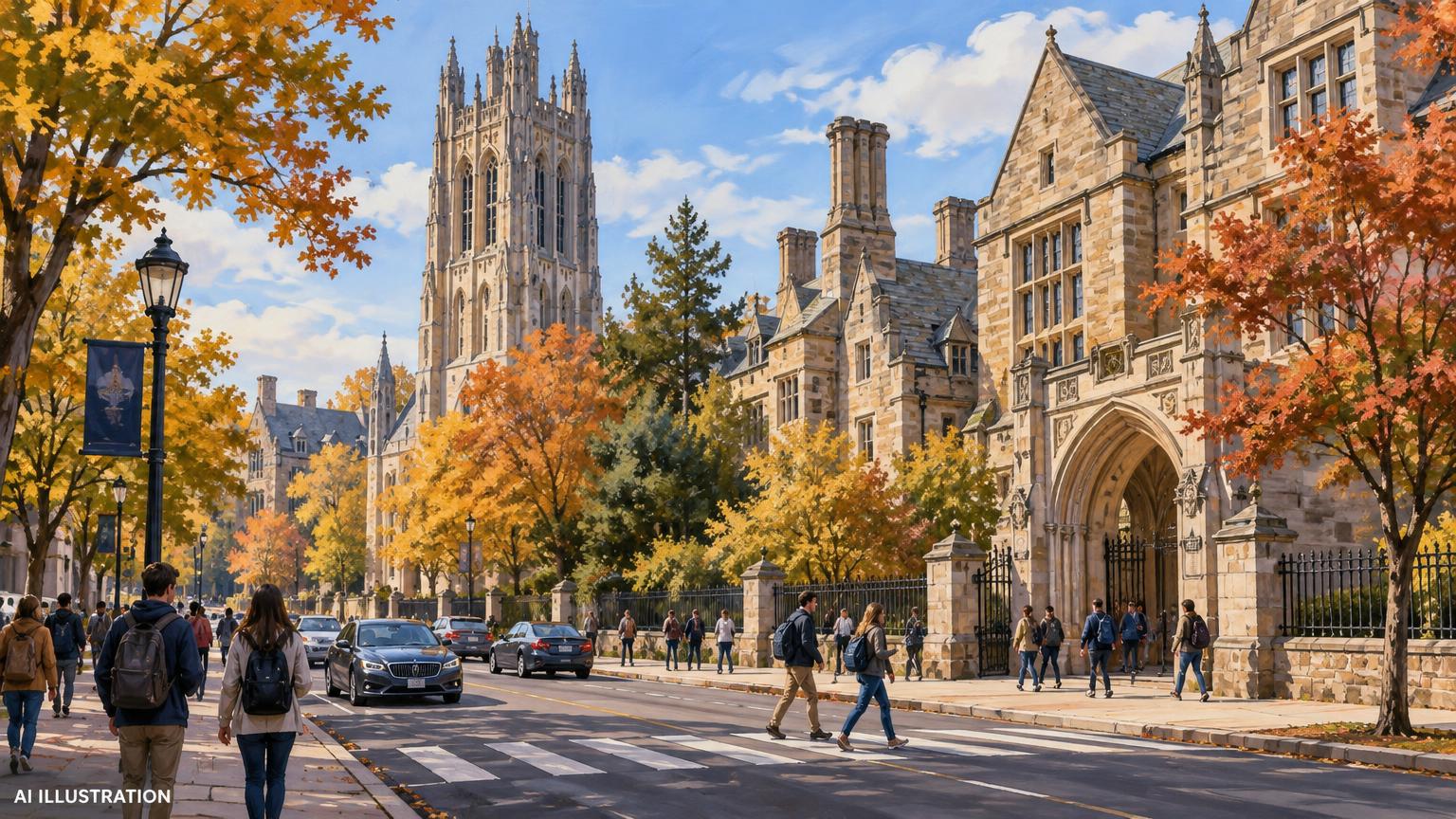
Analysis and opinion. This is an editorial comparison of campus settings, not a safety ranking or an assessment of academic quality.
Yale has the Gothic towers, enclosed courtyards and prestige people picture when they hear Ivy League. Step outside those courtyards, though, and you are in a working city, not a secluded college town.
That contrast helps explain the reaction that Yale might have the least appealing location in the Ivy League. For someone expecting postcard-perfect surroundings at every turn, New Haven can be a tougher sell than Princeton or Hanover.
But calling it the worst is a preference, not an established fact. The more useful question is what you want outside the classroom.
The case against Yale's location
New Haven occupies an awkward middle ground for some prospective students: it is not a small, quiet college town, but it also does not offer the scale of New York, Philadelphia or the Boston area. If your ideal is either a residential retreat or a huge city's endless options, that middle ground may disappoint.
Yale describes its setting as a walkable urban campus. Its buildings are woven into a city street network rather than contained inside one uninterrupted university enclosure. That can mean street crossings, passing traffic and a different atmosphere from the protected feel of an interior courtyard.
The city's transportation studies address roadway conditions and traffic safety. Those are legitimate considerations when imagining a daily walk or bike ride, although they do not establish that Yale has worse streets than other urban universities.
The strongest criticism is about fit: Yale may feel less relaxing than a small-town campus without delivering the big-city experience a student might prefer instead. That is an editorial judgment, not something an admissions brochure or crime table can settle.
Safety belongs in the discussion, not in a sweeping label
Students and families should examine safety at every campus they consider. Yale lists campus safety resources, while its Clery information provides reporting context.
This article does not establish that Yale is the most dangerous Ivy, or that New Haven is uniformly unsafe. A citywide crime rate and a university's campus report describe different geographic areas and cannot simply be placed side by side as a fair ranking.
A useful visit includes the routes you would actually walk between housing, classes, transit and evening activities. Ask about transportation and safety services, and read each school's reports with their boundaries and definitions in mind. A striking incident or an unfamiliar street is not a substitute for comparable evidence.
What the other seven locations offer
There is no single Ivy League setting. Here is the short version, with the trade-offs framed as preferences rather than rankings:
- Harvard, Cambridge, Massachusetts: An urban setting with the Boston region close by. Harvard's visitor directions place the Red Line's Harvard stop across from Harvard Yard. It is a strong option for someone who values city access, but not an escape from city activity.
- Brown, Providence, Rhode Island: A city setting that can appeal to students seeking an urban experience on a smaller scale. Brown's visitor page notes Amtrak and MBTA service at Providence station, a walk or ride from campus.
- Dartmouth, Hanover, New Hampshire: A small Upper Valley town, contrasting sharply with New Haven. Dartmouth describes its main campus as 269 acres. Its setting may suit a student prioritizing a smaller community over metropolitan variety.
- Columbia, New York City: The main campus is at Broadway and 116th Street in Manhattan's Morningside Heights. For someone who wants New York, that location is the attraction. For someone seeking quiet surroundings, it may be the objection.
- Penn, Philadelphia: Another unmistakably urban option, in a much larger city than New Haven. Penn's visitor information is a starting point for exploring its University City setting. Yale is not the only Ivy where the university and city meet.
- Princeton, Princeton, New Jersey: A smaller-town setting that may better match the traditional residential-campus ideal. Its visitor page offers campus and travel information. Choosing that atmosphere over New Haven is understandable, but still subjective.
- Cornell, Ithaca, New York: A Finger Lakes setting with a different relationship to landscape and city life. Cornell's location guide describes Ithaca and the region. The greater remove from major metropolitan life can be a benefit or a drawback.
New Haven's strongest counterargument
The city offers more than the blocks that make a first impression. Yale's New Haven guide highlights international dining, independent shops, theaters and the International Festival of Arts & Ideas. It is a university promotional source, but the cultural institutions it points to are real reasons to spend time in the city.
The Yale University Art Gallery, Yale Center for British Art and Peabody Museum add substantial cultural depth. New Haven's pizza tradition and restaurants give students reasons to leave campus rather than treat the surrounding city as an inconvenience.
Rail access is another practical advantage. Yale's campus living resources describe shuttle connections with New Haven train stations. That does not make every journey effortless, but it distinguishes the setting from a more isolated college town.
The verdict
If the priority is a quiet, cohesive college-town atmosphere, it is reasonable to prefer Princeton or Dartmouth to Yale. If the priority is the scale and energy of a major city, Columbia, Penn or Harvard may be more appealing.
New Haven's appeal lies somewhere else: an urban university with a distinctive local food scene, major cultural institutions and useful regional connections.
Yale may have the least appealing Ivy location for your preferences. That is a fair opinion. Saying it has the worst location for everyone misses what other students value about New Haven.
Cover: AI-generated architectural illustration inspired by Yale and New Haven, not a documentary photograph of a specific street.