MIT's 4,600-camera campus: safety system or Big Brother?
MIT's expanding camera network has drawn privacy protests. The university says it has paused AI exploration and does not use facial recognition or record audio.
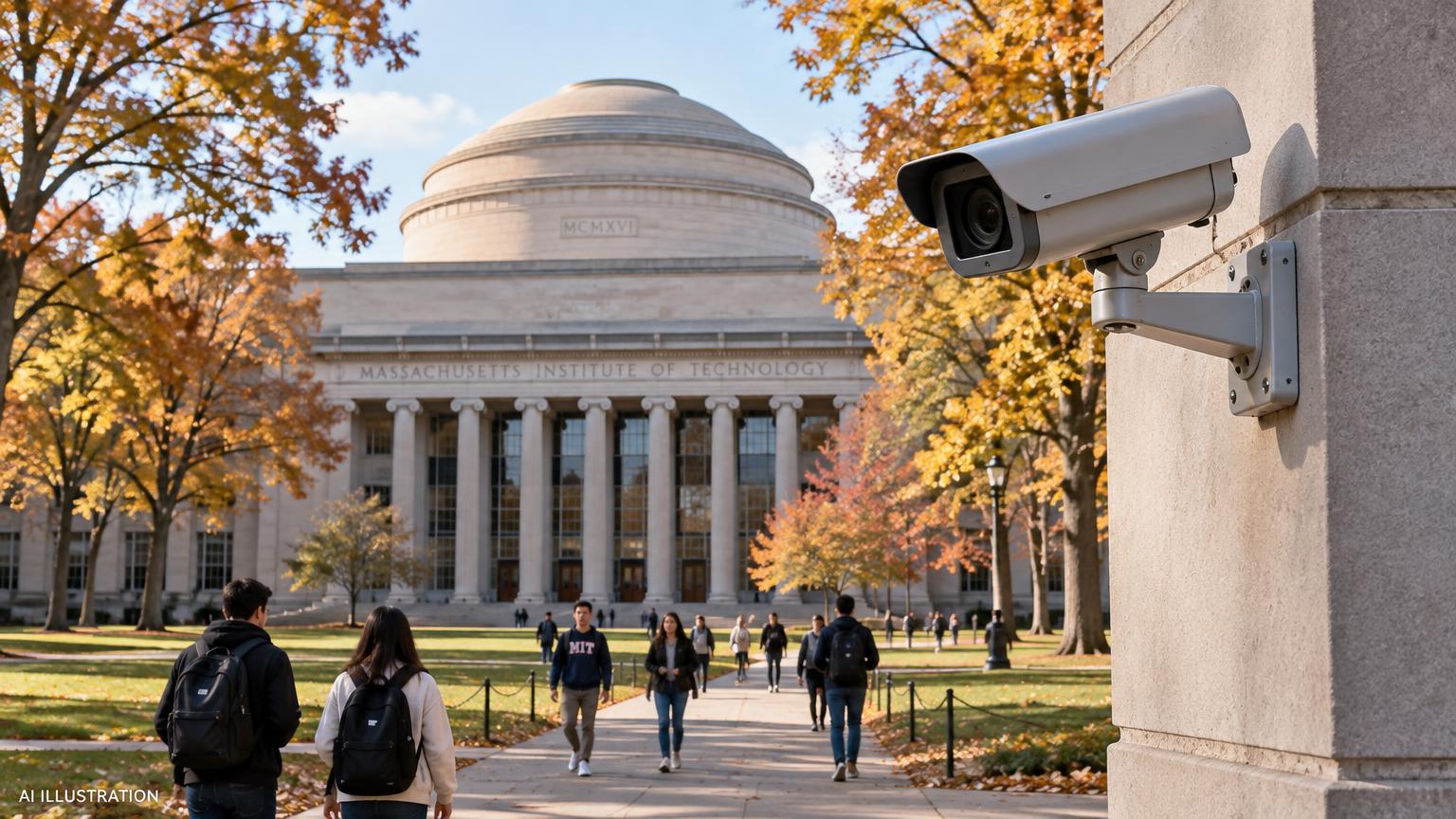
Analysis. Based on MIT's published policies and independent reporting, including MIT's account of its October 21, 2026 faculty-meeting update.
About 4,600 security cameras on a 168-acre campus. Building-access records generally kept for 90 days. Camera footage that can, with approval, enter student disciplinary proceedings.
Those documented practices give the “Big Brother” comparison something concrete to rest on. But the comparison also needs an important qualification: MIT says its current security camera program does not use AI to observe or analyze campus activity, does not use facial recognition, and does not record audio. 2
The real debate is not whether surveillance exists. It is how much is justified, what happens to the records, and how the campus community can verify the limits.
A large camera network, and a visible backlash
MIT's camera FAQ puts the network at about 4,600 cameras across 168 acres and 14 million square feet of academic, research and residential space. The university says an expansion beginning in November 2025 responded to theft, vandalism and property damage that exposed gaps in coverage. Those figures describe a substantial network, but are not a count of people being watched or a comparison with other campuses. 2
In April, The Tech reported that MIT was spending more than $3 million on over 500 additional cameras. The student newspaper reviewed project documents and technical specifications describing hardware capable of AI-based face and object detection and classification.
The objections became unusually visible this month. Cambridge Day reported on October 7 that faculty members decorated cameras with rhinestones and googly eyes to draw attention to the expanded network. The newspaper said the decorations did not obstruct their operation.
That protest illustrates the privacy concern: even when no one is watching every screen live, extensive recording can change how people experience a campus.
AI-capable is not the same as AI in use
The distinction matters. A camera's technical ability to classify a face or an object does not establish that those features are enabled. Face detection also is not the same as identifying a named person through facial recognition.
MIT's latest FAQ says it has paused exploration of AI use after discussions with an advisory group of faculty, staff, students and postdocs, and other community members. It also describes a completed, time-limited pilot under an agreement with Ambient.ai, including staged safety scenarios, and says all data has been purged from the company's portal. Those are MIT's statements, not findings from an independent technical audit. 2
The October update is important context for earlier coverage of AI-capable cameras. It would be misleading to present the earlier hardware specifications as proof that MIT is currently using AI to track students.
Who can see footage, and how long is it kept?
MIT's published camera protocols, updated in August 2026, say recordings are retained for 30 days unless connected to a specific incident under review or retained as required by law. The policy does not set a separate maximum period for those exceptions. Authorized MIT Police personnel can view archived footage, and designated IT staff have administrative access to support the system. 1
The same protocols permit limited, case-by-case access by other MIT units investigating policy violations, with written approval from a senior officer. The FAQ explicitly says footage can be shared with the Committee on Discipline for student disciplinary proceedings with that approval, while describing such use as rare. 2
Outside sharing is another consequential part of the rules. MIT says police may share footage with state and local law enforcement investigating significant public-safety incidents captured by its cameras. For other law enforcement agencies, the FAQ says MIT would supply footage only through valid legal process, such as a subpoena or search warrant. 2
Door-access records add another layer
MIT's access-control policy says its systems collect the locations, dates and times where ID cards are used, with records generally retained for 90 days. IT staff may use logs for maintenance and troubleshooting; MIT Police may request them for criminal investigations. Other requests require Campus Safety Working Group approval. 5
These records document credential use at access points. They do not, by themselves, establish continuous tracking of someone's movements, and they are a separate system from camera video. Still, the existence of both kinds of records makes questions about access and oversight reasonable.
The accountability question
MIT says police generally do not watch camera footage in real time, with limited exceptions such as large university events and legally required monitoring of critical infrastructure. That is different from a claim that every student is continuously being watched by an operator. 2
The Campus Safety Working Group describes monthly meetings and oversight of physical-security systems, installation requests and access to video. That establishes a governance structure. It does not, on its own, demonstrate how frequently access is audited or what results are made public.
The questions worth pursuing are specific: Are analytic features technically disabled and independently checked? How is access to footage audited? What determines deletion of incident-related recordings? What opportunity does the community have to challenge an expansion or proposed new use?
The bottom line
“Big Brother” is an opinion about the scale and consequences of monitoring, not a verified finding that MIT uses facial recognition or watches everyone's movements in real time.
The documented camera network and access logs justify a serious privacy debate. MIT's stated limits and pause on AI exploration deserve equal prominence. The strongest critique is about transparency and accountability, not capabilities that have not been shown to be in use.
Cover: AI-generated illustration inspired by MIT's campus. The camera placement is illustrative, not documentation of a particular installation.